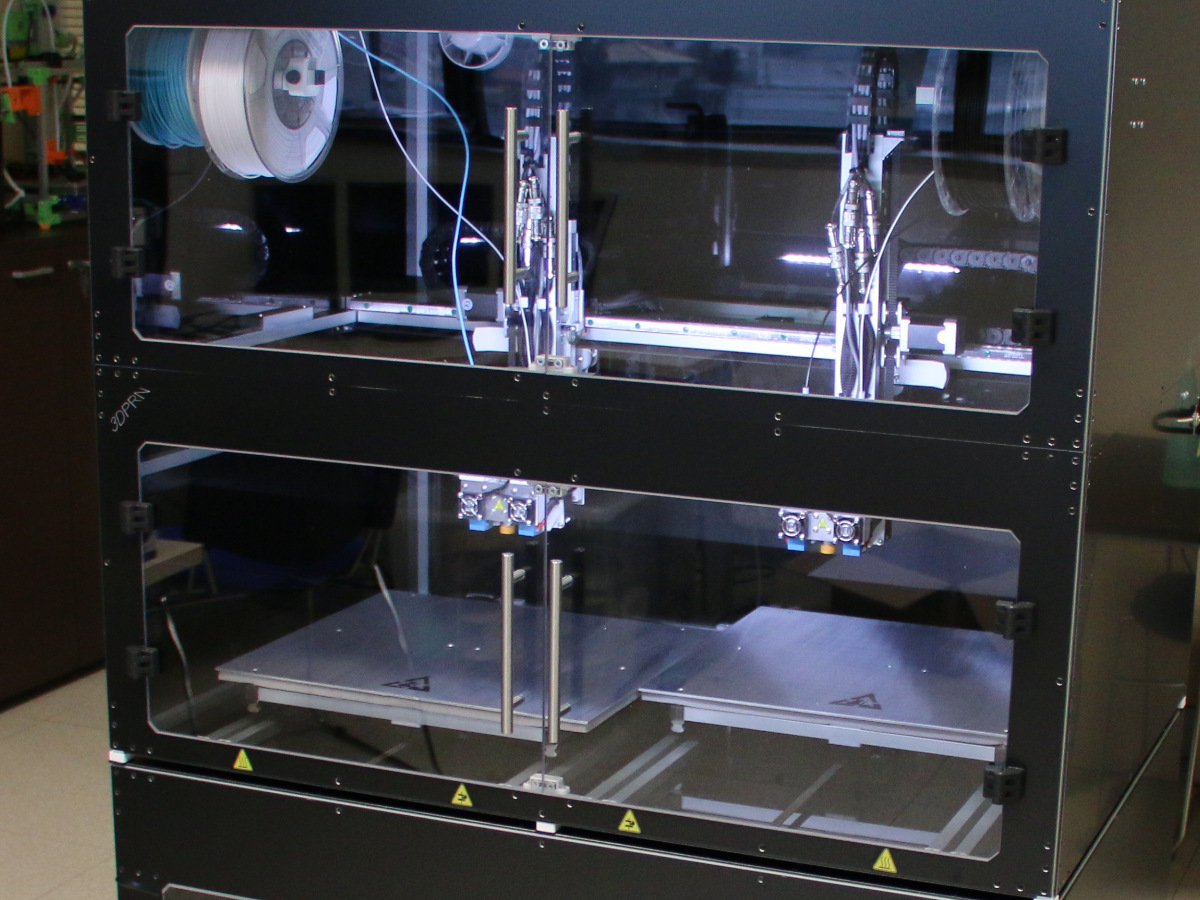
Large-scale 3D printing offers new possibilities for companies needing to produce prototypes, technical components, tools, models, and custom parts. However, when working with large objects, choosing the right additive manufacturing technology and the most suitable material is crucial to achieving precise, durable, and cost-effective results.
There’s no one-size-fits-all solution for every project. The most suitable technology depends on factors such as the size of the part, its geometry, the required level of precision, its function, the production volume, and the characteristics of the material being used.
For this reason, before investing in a large-format professional 3D printer , it’s advisable to analyze the entire production process. Making the right choice allows you to get the most out of the machine and reduce some issues related to time, costs, material consumption, and quality.
Why is it important to choose the right technology?
3D printing technology determines many aspects of the process. There are various additive manufacturing systems, each with its own specific characteristics.
For some large-format applications, FFF/FDM technology can be particularly interesting because it allows you to work with different thermoplastic materials and produce bulky components.
Other processes may be more suitable when a particular level of detail, certain surface characteristics, or specific material requirements are required.
The choice should be made taking into account:
- Production volume .
- Precision required.
- Type of geometry.
- Materials to use.
- Production speed.
- Mechanical characteristics.
- Total cost of the process.
The best technology will be the one that meets the real needs of the project.
Evaluate the size of the pieces
The first criterion is to determine the maximum and usual dimensions of the components to be manufactured.
Knowing the dimensions of the largest component that might occasionally appear isn’t enough. It’s equally important to analyze the dimensions of the components that will be produced more frequently. A machine that’s too small can lead to the division of many components, increasing assembly effort. On the other hand, an oversized machine can represent a wasted investment.
The goal is to find a buildable volume that meets current and future needs.
Single-piece or modular production
Using a large-scale 3D printer, it may be possible to make certain components in one piece .
This strategy can reduce the number of joins and simplify some subsequent operations. It can also facilitate the evaluation of a complete prototype. However, dividing an object into modules can be more convenient when the dimensions are very large or when the goal is to facilitate transportation.
Modular manufacturing allows you to optimize each section and subsequent assembly using connection systems designed directly in the CAD model.
The importance of geometry
The geometry of the component also directly influences the choice of technology.
A component with large flat surfaces may present different challenges than a component with complex shapes, curves, and numerous details.
Before printing, it is advisable to analyze:
thicknesses, protrusions, cavities, joint areas and internal structures .
This analysis allows us to determine which technology and configuration offer the best production conditions.
Which material to choose?
The choice of material for 3D printing should be made based on the function that the component will have to perform.
A visual prototype might only require a material that’s easy to print and work with. A functional component, however, might require greater mechanical strength, rigidity, or thermal stability.
Materials that can be used in various professional applications include:
- PLA .
- ABS.
- PETG.
- Polycarbonate.
- Polyamide.
- Fiber-reinforced materials.
- Composite materials .
Each has different characteristics and must be chosen taking into account the final use of the piece.
PLA for prototypes and models
PLA is one of the most popular options in 3D printing and can be interesting for certain prototyping applications.
Its ease of processing allows for the production of models and components primarily intended for dimensional, geometric, and design verification. For large-format printing, it can be a suitable option when mechanical or thermal requirements are not particularly high.
However, for components intended for more demanding conditions, it may be necessary to opt for other materials.
ABS for technical applications
ABS can be used for certain technical components and functional prototypes.
Compared to other materials, it offers characteristics that can be advantageous for specific applications. However, the production of large components requires careful management of thermal conditions.
In large components, it is especially important to control stability during cooling to reduce the risk of deformation.
PETG as a versatile alternative
PETG can offer an interesting balance between ease of printing and certain mechanical properties.
It can be used in functional prototypes, housings, brackets and other components that require more than just a visual representation.
When working with large parts, it is important to properly adjust the printing parameters and monitor adhesion and temperature.
Polycarbonate for demanding applications
Polycarbonate belongs to the category of technical materials that can be used when specific characteristics of resistance and thermal stability are required.
Its processing can be more complex than that of conventional materials. Therefore, the printer must be properly configured and offer the necessary conditions to work with this type of polymer.
The choice of polycarbonate can be interesting for certain functional components and technical applications .
Polyamides for functional components
Thanks to their mechanical properties, polyamides can be used in various industrial applications.
Depending on the formulation and process, they can be suitable for functional parts, technical components, and certain elements subject to stress. In large-format 3D printing, material behavior must be carefully controlled to maintain adequate dimensional stability.
Fiber-reinforced materials
Fiber-reinforced materials expand the possibilities of professional additive manufacturing.
The incorporation of carbon fiber or other types of fibers can improve certain properties, particularly stiffness. These materials may be of interest for the production of tools, supports, and components that require a combination of lightness and strength .
However, they require equipment and parameters compatible with their characteristics.
How to choose the right material
The choice of material should start from a fundamental question: what is the function of the work?
From there, you can define your needs.
For example, if the component is primarily intended for aesthetics, printability might be the priority. If it needs to withstand loads, mechanical strength will need to be considered. If it will operate at high temperatures, thermal stability will be more important.
It is also worth considering:
- Mechanical resistance .
- Rigidity.
- Flexibility.
- Operating temperature.
- Weight.
- Surface finish.
- Cost.
- Ease of processing.
Thermal and dimensional stability
In large-scale 3D printing, thermal control is particularly important.
Thermoplastic materials undergo heating and cooling processes during manufacturing. Temperature differences can cause shrinkage and deformation. The larger the component, the greater the potential impact of these phenomena.
Therefore, when choosing a technology, it is necessary to consider its ability to maintain stable production conditions throughout the entire process.
The relationship between material and orientation
The print orientation should also be studied in relation to the material.
In layer-by-layer production, mechanical properties can vary depending on the direction of the layers.
If the component must support a certain load, it is important to orient it consistently with the expected characteristics.
Additionally, proper orientation can reduce the number of supports and improve the finish.
Reduce supports to save time and material
Support structures can significantly increase material consumption. Therefore, the right combination of design, orientation, and technology can reduce this.
Typically, fewer supports means:
- Lower material consumption.
- Shorter print times .
- Less waste.
- Less work later.
- Lower costs.
This optimization can be especially important for large parts.
Internal structures and weight optimization
A large piece does not necessarily have to be solid.
Optimized internal structures reduce weight and material consumption. The filling can be adapted to the mechanical requirements of the component.
For visual prototypes, a relatively lightweight internal structure may be sufficient. For functional components, it may be necessary to increase density or use a different internal geometry.
The goal is to find the right balance between strength, weight, time and cost .
production speed
Printing speed should always be evaluated in relation to quality.
A machine capable of printing quickly can reduce production times, but if that speed causes defects or increases the number of defective parts, the end result can be counterproductive. For large-format jobs, the total time can be considerable. Therefore, an optimized configuration should prioritize production stability, not just maximum speed.
Dimensional accuracy and quality
A professional 3D printer must offer precision appropriate to the type of component to be produced.
In large parts, small deviations can accumulate and affect the final dimensions. Accuracy depends on the structure, motion systems, thermal control, material, and configuration.
For this reason, it is advisable to evaluate the actual accuracy and repeatability and not just the theoretical resolution data.
The role of software
Print preparation software also influences the choice of technology.
A good system allows you to control orientation, supports, infill, and various parameters.
In large-scale component manufacturing, these tools are particularly important because they allow you to optimize the process before it even begins. Proper digital preparation can help reduce time, materials, and errors.
3D printing and the choice of technology and materials
Within the large-format professional 3D printing sector , 3DPRN is associated with solutions oriented towards large-scale additive manufacturing.
To select the most suitable solution, it is essential to jointly analyze the machine, technology, and material . Production volume alone is not sufficient to determine efficiency.
It is also necessary to verify which materials can be machined, what level of precision can be achieved and what productivity can be achieved in real-world applications.
Compare the total cost
The choice of a technology should not be based solely on the purchase price of the printer .
It’s also important to consider the costs of materials, energy, maintenance, machine usage time, labor, and subsequent operations. A system that’s initially more economical may generate higher costs if it takes longer or produces a high percentage of defective parts.
For this reason, it is advisable to analyze the total cost per component .
Think about future applications
A company can start using a 3D printer for prototyping and later expand its use to tooling, functional components, or small production runs.
Therefore, it is advisable to choose a technology that offers sufficient flexibility in terms of materials and applications .
A machine that can adapt to different projects can offer greater value in the long run.
What is the best technology?
There is no single large-format 3D printing technology that is universally better.
The choice depends on the project.
If the goal is to produce large prototypes using thermoplastic materials, an FFF/FDM -based solution may be suitable for certain applications.
If another specific feature is the priority, different technologies may be required.
The important thing is to relate the technology to the geometry, material, dimensions, precision and end use .
Choosing the most suitable technology and materials for large-scale 3D printing requires analyzing the entire production process.
Build volume is important, but must be evaluated alongside accuracy, thermal stability, speed, repeatability, compatible materials, and operating costs .
The choice of material should be based on the characteristics the component will need to have. PLA, ABS, PETG, polycarbonate, polyamides, and reinforced materials offer various options and should be used based on the requirements of each application.
It’s also crucial to optimize the CAD model, orientation, support structures, and internal fill. These decisions can reduce material consumption and production times.
For businesses, the best solution will not necessarily be the largest or fastest printer, but the one that strikes the right balance between quality, productivity, flexibility and cost .
The evolution of large-scale additive manufacturing continues to expand its industrial applications. Thanks to the combination of new technologies, engineered materials, and digital design, large-scale 3D printing can become an increasingly important tool for the efficient production of prototypes, customized components, equipment, and small series.


